Rhubarb, Rhubarb, Rhubarb... the "peculiar advantages" of a rhubarb forcer

Rhubarb Forcers at the Oxford Botanic Garden. My photo, September 2019
Quote in the title from Thomas Hare, Assistant Secretary of the Horticultural Society of London, May 1816
Well, I admit it. I have a thing about rhubarb forcers! I’ve always liked garden ‘ornaments’, be it eye-catching, strategically placed empty pots, or rusty metal garden 'things' amongst the borders – and rhubarb forcers are, I think, rather elegant. I’ve had one in the garden for a while, but only started to grow rhubarb 3 years ago after we moved to rural Herefordshire. And my husband, knowing my gardening quirks, bought me a lovely Victorian forcer from a local antique shop, sourced from the walled garden of a nearby old Worcestershire estate.
My Victorian rhubarb forcer. It mostly sits underneath Yew trees in the garden as I only occasionally use it to force rhubarb in the vegetable bed. Somewhat unusually, the lid survived.
My photo, 2022

I initially thought this would just be a fun post with some nice pictures of rhubarb forcers – as I snap a pic of all those I come across, with perhaps some adverts from the Victorian horticultural press. But there's actually some quite serious garden history here involving the Chelsea Physic Garden in London, as well as some of the horticultural elite of the early 19th century, including the rather wonderful Thomas Andrew Knight [whose fast becoming another of my horticultural heroes, see my post Apple Stories Part 3: Thomas Andrew Knight (1759-1838) – the RHS, pineapples, and the ‘Pomona Herefordiensis’]. I've also taken a look at two of the most prominent rhubarb forcer producers of the time, potteries based in Nottingham and Weston-super-Mare.
But before I get on to how rhubarb forcers came about, let's have a quick look at the humble rhubarb itself. [Oh, and I have sprinkled this post with my favourite rhubarb forcer photographs!]
An Introduction to Rhubarb
Rhubarb is another of those remarkable but tricky plants which, as the RHS puts it, is “a vegetable that thinks it’s a fruit; a medicinal purgative [it’s thought it was the Chinese, who else, who first used rhubarb plants – not to eat, but for medicinal purposes] that became a delicacy; grown in the dark… [and] a treat for the eyes as well as the tastebuds” [Note 1].
'The Chinese Rhubarb (Rheum palmatum)'. From 'Medical Botany', 1836 by John Stephenson and James Morss Churchill. Public domain

Rhubarb ended up in classical Greece at some point, again used medicinally, and it was only with the establishment of the 'silk road' trade routes that it finally reached the rest of Europe during the 14th century, where it became known as ‘Turkish rhubarb’, probably a mix of Rheum palmatum and R. rhaponticum.
As it was expensive to transport, rhubarb was, at this time, even more costly than spices such as cinnamon and saffron. And although the precise origin of the rhubarb that we actually eat is not known, its high price encouraged efforts to cultivate different species of rhubarb in Europe, R. rhaponticum x R. officinale being grown in England.
One of the earliest Western records of the rhubarb plant is in Dioscorides’ herbal, 'De materia medica' (50-70 CE). Dioscorides referred to it as 'Rha' and praised its medicinal properties. Illustration of Rhubarb (Revbarbaro), from Pietro Andrea Mattioli’s Italian translation of Dioscorides’ 'De materia medica', 1568. Public Domain

Rheum rhaponticum x R. officinale is recorded as being introduced to the Botanical Garden in Edinburgh in 1774, but in England it's even earlier. Quaker merchant, Peter Collinson (1694-1768), who was also a gardener and botanist, sent Philadelphia farmer-cum-plant-hunter, John Bartram (1699-1777), seeds of both medicinal and culinary rhubarbs which Bartram grew in his garden from the 1730’s [for more information on this transatlantic seed trade, see my posts The 'Curious and Noble' Robert James, 8th Baron Petre of Thorndon Hall and James Gordon: 'a most Knowing and Ingenous' gardener, nursery and seedsman].
The nature print below of a rhubarb leaf was made in Philadelphia [probably from a plant grown by Bartram himself, or Joseph Breintnall, the print-maker], documenting the rhubarb Collinson sent prior to 1737. Collinson writing to Bartram in September 1739 that rhubarb makes “excellent tarts before most other Fruits fitt for that purpose are ripe…”. [Note 2]. Collinson even provided him with a recipe for rhubarb, advising that a good way to eat it was to cut the stalks into pieces and “putt them in Crust [pastry] with sugar & a little Cinnamon [very similar to my own rhubarb crumble recipe!], then Bake the Pye or Tarts Eats Best Cold” adding that “it is much admired here…[and] eats most like Gooseberry Pye” [Note 3].
Rhubarb leaf nature print made by Joseph Breintnall, dated November 23, 1738, with the note “A Leaf of Rhubarb and withered. Somewhat hurt by the Frost". [This is likely Rheum rhabarbarum.] From Breintnall's 'Nature Prints of Leaves', Vol. 1, 1731-1744. Courtesy Library Company of Philadelphia

Today there are many cultivars of rhubarb grown for culinary uses, most of which are recognised by the Royal Horticultural Society as Rheum x hybridum. The RHS holds the UK’s national collection of rhubarb comprising some 103 varieties, and this collection was moved to their new northern garden, RHS Bridgewater, in 2021-22 where the colder and wetter winter conditions are better suited to the plant.

Rhubarb – The RHS's Quick Facts www.rhs.org.uk/fruit/rhubarb/grow-your-own

Rhubarb – the RHS's 'forcing' advice www.rhs.org.uk/plants/horticulture-hub/national-plant-collections/rheum
Pair of vintage Rhubarb Forcers. Image courtesy Decorative Garden Antiques

Rhubarb 'forcing': the historical bit
The use of rhubarb stalks for food is first recorded in England during the 18th century after sugar became more widely available, and affordable – garden historian, Susan Campbell, describing how it was cultivated in vegetable or kitchen gardens [see Note 4]. First grown out in the open “without blanching, to be picked for eating in the summer”, rhubarb grown this way was not particularly tasty as it usually produced thin, stringy, and rather acidic stems [probably why Collinson recommended the addition of sugar and cinnamon].
It was not until the early 19th century, with the discovery that rhubarb could be ‘forced’ or 'blanched' to produce much sweeter stems, that it became more popular in the kitchen – mostly used in fruit tarts when the usual summer fruits such as apples and gooseberries were not yet in season. [And if you're particularly interested in early rhubarb recipes, please have a look at this article at the lovely cookery website, Coquinstia, Rhubarb recipes from the nineteenth century]
Jim Keeling, of Whichford Pots fame, writing in his book, flowerpots [Note 5], is just one example of a multitude of sources which state that in 1815 it was a chance discovery at the Chelsea Physic Garden in London that ‘forced’ or 'blanched' rhubarb stems made good eating, when a patch of rhubarb was accidentally covered over by a bucket [according to some sources], or accidentally buried with earth [according to others]. It's not clear who actually discovered this – probably one of the gardeners, but the end result was several papers published in the journal of the Horticultural Society of London [later the Royal Horticultural Society] reporting on the 'discovery'.
Rhubarb forcers at the Chelsea Physic Garden in London. My photo November 2023

Later, according to Keeling, Thomas Andrew Knight and the Head Gardener on one of his estates “went on to devise a long clay pot to ‘force’ the crop by denying it light, giving the pink delicate stems we know today”. Such a pot at some stage morphing into what we now call rhubarb forcers. This method produced rhubarb which grew straighter and taller than normal and, with the absence of light limiting photosynthesis, sweeter – all leading, according to the Chelsea Physic Garden website, “to the forcing of rhubarb becoming a well-known horticultural technique” [Note 6].
And so as usual I’ve gone back to the primary sources to see what Thomas Andrew Knight (1759-1838) had to say about the matter. Knight, a horticulturist and botanist, was instrumental in the early days of the Horticultural Society of London, serving as its second President for many years. Famed for his practical experiments, mostly with fruit [breeding many new varieties], Knight wrote extensively about various horticultural subjects [46 papers for the Royal Society and over 100 for the Horticultural Society’s journal].
'Rheum foliis cordatis glabris'. Plate CCXVIII, engraved by J. Miller after Richard Lancake, from ‘Figures of the Most Beautiful, Useful and Uncommon Plants described in The Gardeners Dictionary’, Vol. II by Philip Miller, 1760. Public Domain

In May 1818, Knight's paper, On a Method of Forcing Rhubarb in Pots [Note 7], was read to a meeting of the Society regarding his experiments. Knight doesn't actually tell us anything in particular detail, apart from that by placing rhubarb crowns “in a few large and deep pots” with the tops covered by other pots – these then being placed in a dark “vinery”, he obtained a succession of early crops. However, a paper published in the Society's journal by its then Assistant Secretary, Thomas Hare, two years earlier [Note 8], is actually more forthcoming.
Hare describes the accidental 'forcing' discovery at the Chelsea Physic Garden in 1815, writing that in the early spring of that year a trench was dug through a rhubarb bed. Some of it became buried by the earth [no mention of a bucket here], and it was later discovered that the emerging rhubarb stalks were found to “possess… peculiar advantages”. Namely, two advantages for its culinary use: “the desirable qualities of improved appearance and flavour, and a saving in the quantity of sugar necessary to render it agreeable to the palate, since the leaf-stalks when blanched are infinitely less harsh than those grown under the full influence of light in an open situation”. [During this period, coarse brown sugars had become relatively affordable, although pure, highly refined, white sugar remained expensive.]
Yet another paper, also read at a meeting in May 1818 [Note 9] by a Daniel Judd, gives detail about how forcing garden rhubarb using pots was actually achieved. Judd covered the crowns with “common garden pots, called twelves, having their holes stopped” – probably not unlike the upside down pot on the left in the photograph below, this one having its hole covered by an old forcer lid.
3 tall rhubarb forcers in the walled garden at NT Tyntesfield. A 4th [on the left] is a converted plant pot. Photograph courtesy Oliver Kent from his article ‘Tyntesfield, Somerset – The Plant Pots’, October 5, 2015. From the blog ‘Clay and Fire’ – see Acknowledgements

The rhubarb did well, but it broke Judd's pots. However, as this method greatly improved the flavour of the rhubarb, the following year he “had large pots made on purpose, without holes…”. Unfortunately, the plants broke these pots as well – Judd noting that as “this sort of Rhubarb grows so very luxuriantly, it is impatient of such confinement” [I feel his pain – see photograph below of rhubarb having pushed the lid off my forcer! Fortunately, nothing was broken.]

A 'forced' clump of rhubarb 'Early Temperley' in my garden. My photo, March 2024
After this further failure, Judd tried a different forcing method but concluded that, while using pots was definitely “a superior method”, pots were probably better suited to smaller species of rhubarb.
And here a note re 'twelves'. In the context of garden pots of this period [and into the Victorian era], ‘twelves’ refers to the sizing convention used by British potteries such as Sankeys [a major manufacturer of rhubarb forcers – discussed later]. Under this system ‘twelves’ meant 12 pots made from a single casting from a standard measure of clay. The number indicated the size of the pot, i.e. the lower the number, the larger the pot. ‘Twelves’ were traditionally 8.5" to 9” in diameter. Today, such original vintage pots are highly sought after.
A set of mismatched antique ‘twelves’ garden pots for sale from 3 different manufacturers, including Sankeys. 10x 8.5” and 2x 7.5” pots. Image courtesy www.

What happened next?
So, what of the years following this momentous discovery – and the pontifications of various learned early-19th century horticulturalists?
Following the flurry of papers on this subject from the worthy gentlemen of the Horticultural Society, it wasn't long before this forcing process began to be mentioned by garden writers. For example, John Claudius Loudon’s An Encyclopaedia of Gardening, 3rd Edition, 1828, mentions ‘blanching-pots’, used for sea-kale and rhubarb, as “a recent invention”, quoting from the papers of both Hare and Knight on the subject.
By the mid-19th century, rhubarb was certainly a popular crop as can be seen in these advertisements from The Gardeners' Chronicle in October 1860 [below], showing different varieties for sale. Rhubarb was also exhibited at flower shows, along with other vegetables, and at one time there were even specific 'rhubarb shows'. I came across an article titled ‘Rhubarb Shows’ in The Gardening World of November 29th, 1890. The unnamed article’s author lamenting the lack of such shows at the time of writing, and harking back some 40-50 years when they were popular, particularly in “northern and midland districts”. I'm not going to discuss such shows here, but if you’re interested, here’s a link to the article https://www.biodiversitylibrary.org/item/272992#page/163/mode/1up
Adverts for Rhubarb from 'The Gardeners’ Chronicle', October 27, 1860

According to the Victorian horticultural press, growing rhubarb in covered trenches, or in mushroom houses [a popular location], i.e. keeping them in the dark and supplying them with manure and therefore heat, was usually employed for growing rhubarb in quantity, either for commercial purposes, on grand states or large gardens, rather than using pots. [This is the advice for example in The Gardeners’ Chronicle, October 20, 1860.]
By the later years of the 19th century, this is still the advice – The Garden, October 24, 1885, states that forcing this way produces “the finest Rhubarb”.
Even as late as May 1898, an article in The Gardeners’ Magazine points out that rhubarb, being “highly prized in most households before Christmas”, is still mostly grown in open ground with the crowns covered with compost and/or manure [Note 10]. The author of this article is of interest. He was Edwin Beckett, Head Gardener at Aldenham House in Elstree who, together with its owner, Vicary Gibbs (1853-1932), transformed the grounds into a renowned arboretum and ornamental garden. Beckett, whose kitchen garden was famous in its day [the gardens at Aldenham House often featuring in the horticultural press], wrote that “many modes of forcing are practised…” and although he discusses using "a mushroom house, a warm pit, greenhouse or cellar" to grow rhubarb, he prefers “forcing the plants on the ground”, using “suitable tubs, with the two ends removed, but one end utilised to form a lid”… this method being just as good as so-called rhubarb pots.
However, forcing pots were available – The Garden [as above, October 20, 1860] also pointing out that “There are pots specially made for placing over the crowns, [although] empty casks or old boxes do almost as well…”.
Lidless rhubarb forcers at Croft Castle, Herefordshire. My photo, May 2022

Throughout the first years of the 20th century, this advice continued. The photograph below, showing the use of an old barrel to cover rhubarb crowns, was published in The Garden in May 1902, accompanying an article ‘Simple Methods of Forcing Rhubarb’ – and even in the 1920's garden writer, E.T. Cook, recommended covering rhubarb crowns out in the open "with tubs, boxes, or big pots" to induce "early growth for pulling". This advice accompanied by the same photograph.
‘Forcing Rhubarb with help of old Barrel’. Published in both 'The Garden’, May 10, 1902 – and E.T. Cook’s ‘Gardening for Beginners’, my copy 8th Edition, 1925

And here's a lovely thing – I came across the illustration below from Adam the Gardener, still covering rhubarb crowns with a barrel in 1946 [although it also includes, on the left, an illustration of what suspiciously looks like a rhubarb forcer!]. In 1940's Britain, Adam, who featured in a weekly comic strip published in The Sunday Express newspaper, was considered something of a national treasure. Written by Cyril Cowell, accompanied by illustrations by Morley Adams, Adam advised the British public on how to grow their own food during wartime.
‘How to force your rhubarb’, from ‘Adam the Gardener: A Pictorial Guide to Each Week’s Work’ by Cyril Cowell, 1946. Image courtesy 'GrowVeg' Facebook group

Dig for Victory poster used between 1939 and 1946 to promote the benefits of growing your own. National Archives/Public Domain

Talking of the 1940’s, during the war and food rationing, rhubarb became something of a dietary staple [especially in the winter when fruit was in short supply] – so much so, that the British government controlled its price to just a shilling per pound so it was available to all. According to the RHS [Note 11], by 1943 around 55% of households in the UK were growing some fruit and vegetables – aided no doubt by Adam the Gardener and others.
But sometimes even forced rhubarb needs a little sweetening, and with sugar severely rationed it would have been a somewhat sour treat! According to some writers, rhubarb’s popularity dipped after the war as tropical and other fruits made a come back into the British diet.
But getting back to the 19th century, it's not until the 1860's that I find advertisements in the horticultural press for potteries selling 'Rhubarb Pots' – like this one below from Sankeys [discussed later – see Potteries].
Advert from The Nottinghamshire Guardian, June 14, 1867. Courtesy Richard Sankey & Son Facebook group

While researching this post, I've spent considerable time trawling through the pages of the horticultural press looking for something we'd actually recognise as a rhubarb forcer – and I'll admit to having nearly given up when, finally..., I came across drawings of some proper rhubarb forcers, featured in The Gardener’s Assistant from 1910.
Rhubarb Forcers in the early 20th century
And here The Gardener's Assistant is worth a mention. The Garden Museum in London featured this publication as its ‘Object of the Week’ in January 2021, describing it as something of a ‘bible’ for working gardeners in its day – it’s subtitle being ‘A Practical and Scientific Exposition of the Art of Gardening in all its Branches’. It is indeed a great resource for garden historians, but I've not used it before as its volumes covering the Victorian period are not available on-line [which is how I do most of my research these days]. I'll be writing about this publication in due course but fortunately, for the purposes of this post, its later [fully revised] volumes for 1910 are on-line [6 volumes from 1910, see Note 12 for link].
It's in a chapter on Tools and Instruments [vol.1, 1910], that The Gardener’s Assistant takes a look at garden pots, and provides nice drawings of ‘blanching pots’ for both sea-kale and rhubarb [below]. The accompanying text describing how 'The Blanching Pot' (g and h),"an earthenware pot made in various shapes... [with] a top which may be removed", allows a peek at the plant to see if it's ready to harvest without having to lift the whole pot. The squatter shaped pot [g] was for sea-kale, while the taller [h] was for rhubarb. Although it has to be said that the different shaped pots do seem to be interchangeable.
'Figure 243', images of 'g. Sea-kale pot' and 'h. Rhubarb pot' from 'The Gardener’s Assistant by Robert Thompson of the Royal Horticultural Society’s Gardens, Chiswick. New Edition revised and entirely remodelled under the direction and general editorship of William Watson, Curator, Royal Gardens Kew', volume 1, 1910

'Figure 1273 – Rhubarb Pot' from 'The Gardener’s Assistant ', volume 6, 1910

A later edition of The Gardener’s Assistant [vol. 6, 1910], provides another description of the method for forcing rhubarb [as well as still in pits, cellars, and mushroom houses]. Using a pot as shown in these two images, and providing heat by surrounding the pot with manure during the autumn, would produce edible stalks for the table by Christmas and the new year.
It also pointed out that the varieties of rhubarb grown for culinary purposes in the UK “are much appreciated by Britishers… both on account of their flavour, and also as wholesome food. They form an excellent substitute for fruit in tarts and pies. They also make a delicious preserve, and a wine is obtained from them”.
'Figure 1274 - Section of Rhubarb-forcing pot with manure'
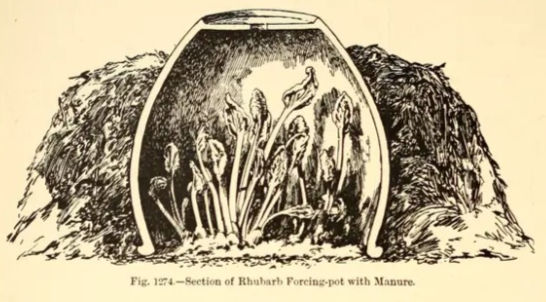
So now I've finally found what I consider to be proper rhubarb forcers in the horticultural press, I'll take a look at the main pottery producers.
The Potteries - A Brief Introduction
Until the 19th century, the pottery trade had been very much a ‘passed-down’ father to son skill. But as the popularity of gardening grew, with “every conservatory or estate garden having at its core sheds full of common terracotta pots” – used from everything to starting off seedlings to “growing plants to the right size for transplanting”, small cottage industry sized potteries just couldn't cope [Note 13].
A collection of old plant pots in the potting shed of the walled garden at NT Tyntesfield. A familiar sight even today in many historic gardens open to the public. Photograph courtesy Oliver Kent from his article on Tyntesfield, October 2015

For example, the accounts for Highclere Castle during the early 1800's [referenced in a Garden History journal article, Note 14], contain a record showing the monthly purchase of 'sundry'* garden pots – all ordered from local potteries:
November 1814: 304
January 1818: 552
and, July 1823: 666
With such high demand, many more of the new industrial-sized potteries began to include horticultural terracotta amongst their products. [*'Sundry' garden pots usually being the various sized 'twelves' pots mentioned earlier.]
The two main, and probably best-known, manufacturers of horticultural pots – including, eventually, forcers, or blanching pots as they were also known, were The Royal Pottery [sometimes also referred to as The Royal Potteries] and Sankeys.
The Pot Manufacturers
John Matthews, The Royal Pottery
Once upon a time, the seaside town of Weston-super-Mare had a pottery industry. Brickyards and potteries thrived in th area due to local deposits of a particularly suitable clay, and one in particular is important in the rhubarb forcer story. Starting off as a brickyard in the 1830’s, the company joined forces with another pottery in 1847, and the new joint enterprise became The Royal Pottery.
This led, according to the local Weston Museum [Note 15], to the company's most productive period, as The Royal Pottery added flowerpots and garden ornaments to its range of products – even exhibiting at the Great Exhibition at Crystal Palace in 1851. Such was the success of their exhibits that they received an ‘Honourable Mention’ and the orders came flooding in, with customers including the Royal Parks and Kew Gardens.
'John Matthews, The Royal Pottery'. Advertisement from 'The Gardeners’ Chronicle', January 3, 1874 – including Rhubarb and Seakale Pots

However, this success didn't last. By 1888 the company was sold and the new owners concentrated on the building side of the business. After a building boom in the 1920’s, the 1930’s saw a return to the production of flowerpots as economic problems led to a downturn in building.
A photograph of The Royal Pottery workforce, 1928. Courtesy Weston Library

Pot production resumed after the 2nd world war, but the business never really got going again despite a large ‘royal’ order in 1952 for 126,000 flowerpots for use in displays to celebrate the Coronation of Queen Elizabeth II. The impact of newly introduced plastic pots signalled the end, and the factory closed in 1961 after 125 years of nearly continuous production. Today, antique, hand-thrown, terracotta rhubarb forcers produced by The Royal Pottery are highly sought after – and are notable for their makers’ stamp, as shown in the photograph below.
Large reclaimed Victorian antique terracotta rhubarb forcer. Produced c.1871 by John Matthews Royal Pottery based in Weston-Super-Mare and includes his maker’s stamp [This particular pot was for sale online for £350 + VAT] Images courtesy salvoweb.com

John Matthews Royal Pottery's crest and maker’s stamp on the rhubarb forcer

Richard Sankey and Son Ltd [Sankeys]
Advert from The Nottinghamshire Guardian, 14th June, 1867. Image courtesy Richard Sankey & Son Facebook group
According to the article in Garden History noted above, one of the best-known manufacturers of earthenware flowerpots in the world was Richard Sankey and Son Ltd, of Bulwell in Nottingham. Established in 1855, between 1895 and 1939 skilled potters 'threw' pots by hand producing up to 60,000 per day. By 1887, as can be seen below, they were advertising themselves as the largest manufacturers of garden pots in the world.
Advertisement from 'The Gardening World Illustrated', March 12, 1887

'Richard Sankey and Son's Celebrated Garden Pots'. Advert from the Suffolk & Essex Free Press, 30th March, 1892. Image courtesy Richard Sankey & Son Facebook group

Unfortunately, this is the best image of this advertisement that I've come across – the company's wording underneath the picture reads:
"The quality of these Pots is acknowledged to be unequalled. The extraordinary freedom from dirt and mossing, or slime, when in use, together with their porosity, is a quality peculiar to them. They are superior in colour and shape, and are lighter, yet stronger, than any other Pot in the market".
Below the above, 'Opinions of the Press' (although not particularly legible) mention good reviews in The Gardeners' Chronicle, Gardening World and the Journal of Horticulture.
As Sankey clay pots were fired at high temperatures, they were incredibly durable and resistant to winter weather so probably deserved their reputation. They were, for example, endorsed by famous firms of nurserymen and seed merchants of the time such as Richard Smith & Co. of Worcester and William Bull & Sons of King’s Road, Chelsea, as shown in their advertisement below from 1892.
Advertisement for 'Sankeys' famous Garden Pots' from 'The Gardeners’ Chronicle', May 14, 1892

And in 1902, Sankey’s received a Royal Warrant as manufacturers to the King, as can be seen here.
'Journal of Horticulture and Cottage Gardener', November 13, 1902

I've also found a nice quote about Sankey's in H. Rider Haggard's gardening book, A Gardener's Year, my copy the second edition published in 1905. [Haggard, best known as the author of adventure novels such as King Solomon's Mines, featuring his famed creation, Allan Quartermain, was also a keen gardener, and I will be posting about his gardening activities in the future.] Writing about his vegetable garden, where he grew rhubarb amongst other things, Haggard mentions Sankey writing that "we are running short of pots of certain sizes, no new complaint. What becomes of all the pots in a garden is to me a mystery...". Adding that he told Mason, his Head Gardener, "to write to Sankey for one of his catalogues, because (this is not an advertisement) his are the best pots I know... [and] owing, I suppose, to the superior quality of the clay used, they seldom become foul and green".
Sankey’s rhubarb forcers were stamped with the maker’s name, as shown in this image. Courtesy The Vintage Garden Company

An article in The Gardeners’ Chronicle in March 1912, describing a visit to the Sankey pottery, provides some interesting information regarding the production process. The unnamed author writes that the weekly output of flower pots alone at this time was 500,000 – “in addition to pan, earthenware baskets, boxes, bowls, and other ceramic ware used in gardens”.
The article goes into some detail about the methods used to produce the pots; interestingly, even by this date, many of their pots were still hand-thrown – on steam-driven wheels no less, as they were much more durable than those produced by machine. However, some of their cheaper pots [mostly those used in large quantities by commercial growers] were machine-made.
The article mentions that their larger pieces of pottery, most notably rhubarb forcers, were made in two pieces – then joined together before being steam dried and then baked in kilns [if you search on Facebook or Instagram you can find reels of Whichford potters doing just this]. Sankey's operation was quite something! The pottery at Bulwell had 11 kilns, capable of baking over half a million pots at one time. A private railway next to the pottery transported pots to Hull, London, Liverpool and Southampton where they were then shipped to places in the British Empire such as South Africa, New Zealand, Australia, Jamaica and parts of Canada. Their warehouses held several million pots in 30 different sizes ”besides Fern bowls, window boxes, hanging baskets, pedestals and other garden pottery”.
Not surprisingly, both The Royal Pottery and Sankey showed their wares at horticultural shows and exhibitions. The Gardeners’ Chronicle reporting for example that Sankey exhibited ”some of their well-known flower-pots” at the RHS National Chrysanthemum Shows in October and November of 1896, while The Royal Pottery, according to Gardening World Illustrated, showed off displays of “vases and other kinds of pottery” at a Royal Agricultural Show in June 1895.
By the 1960’s, as porous clay pots were no longer viewed as essential to promote plant growth, plastic pots began to take over. Sankey ended its production of clay pots in 1976. And if, like me, you are of a certain age(!), you'll probably recognise the Sankey name and recall their plastic pots [in what we'd probably now consider dubious colours for the garden!] which filled our garden centres during the 1970's and 80's – and still do.
Two lichen-encrusted rhubarb forcers at the Lost Gardens of Heligan, Cornwall. My photo, September 2024

The Rhubarb industry in the UK today
One thing I've not covered in this post is the famed Rhubarb Triangle in Yorkshire, where today farmers produce forced rhubarb in specially built sheds, often harvested by candlelight no less, which benefits from a 'protected designation of origin' certification – just like parmesan and Champagne. If you're interested in knowing more, please have a look at these links:
Summary
I'm always banging on, to whoever will listen, about just what a fabulous subject garden history is – and I love the many garden history 'rabbit holes' I find myself diving down! The subject of rhubarb forcers has turned out to be a case in point. And all just because I happen to like them.
I've learned that rhubarb was a particularly important crop, especially during the early months of the year, when other fruits were not in season. After all, it’s easy to forget that during the 18th and 19th centuries, and even into the 20th century, there were no supermarkets available containing a vast array of produce all year round, so many people grew their own fruit and vegetables in quantity.
Rhubarb forcer in a private kitchen garden in Grange-over-Sands, Cumbria.
My photo, May 2023

The introduction of the more palatable 'forced' or 'blanched' rhubarb was therefore an important development. And involves some interesting garden history, particularly with the flurry of papers published in the journal of the Horticultural Society of London during the early 1800's by important horticultural figures of the day.
This was even remarked upon some years later, in 1830, by Mr William Stothard, Under Gardener in the Experimental Fruit and Kitchen Garden Department of the Society's own garden at Chiswick, who noted, somewhat dryly, that ”the subject of forcing and blanching of Rhubarb has, at different times, occupied the attention of the Society, and Papers on it have been published in the Transactions” [Note 16].
Stothard also noted that "the cultivation of Rhubarb for culinary purposes has of late years been much practiced in private gardens". And it was in gardens that a variety of pots, tubs, buckets and even old barrels were used to cover rhubarb crowns for forcing – while specific rhubarb forcing pots, that we'd recognise today, became a normal and somewhat aesthetic addition to a late-Victorian vegetable garden. Such pots seemingly much in evidence in the walled kitchen gardens of grand estates from where many vintage forcers for sale today are sourced – including my own.
By looking at probably the two most famous potteries of the Victorian period, I've also learned something about the vast quantities of garden pots manufactured, and consumed, by gardens and grand estates at the time, as shown by the records at Highclere Castle.
And to finish, earlier this month I came across some lovely, somewhat larger, rhubarb forcers in the walled garden at Castle Howard in Yorkshire. Originally laid out as a kitchen garden in the early 18th century, it's now split between a rose garden and an ornamental vegetable garden – which is where I came across 4 large forcers strategically placed at each corner of the vegetable garden. Sadly, the gardeners I came across were not able to tell me anything about the forcers or how old they were.
Large Rhubarb forcers in the walled vegetable garden, Castle Howard. My photo, September 2026

As I've written in the 'About' section of my website, my garden history posts are purely a "romp around the subject – touching on stories about gardens, plants, and people that catch my interest", and I've much enjoyed this particular "romp"!
Acknowledgements:
I'm grateful to the following for their assistance:
The Administrator of the Richard Sankey & Son Facebook group for permission to use some of their archival images.
Oliver Kent [Clay and Fire blog] for permitting me to use some of his photographs taken at the National Trust garden of Tyntesfield in Somerset back in October 2015. Taken from his article, Tyntesfield, Somerset – The Plant Pots, in which he describes seeing many old pots with the Sankey Bulwell mark, some from the Royal Potteries, and “in the walled garden itself several tall waisted rhubarb pots…”.
Notes:
1. ‘Rheum x hybridum’. Article by James Armitage, Editor, The Plant Review and The Orchid Review Yearbook, May, 2024
2. 'Did John Bartram introduce rhubarb to North America?' By Joel Fry, Curator at Bartram’s Garden, posted July 20, 2012. Growing History: The Philadelphia Historic Plants Consortium
3. The Correspondence of John Bartram 1734-1777. Edited by Edmund Berkeley and Dorothy Smith Berkeley, published 1992
4. 'The Darwin Family’s Kitchen Garden at the Mount, Shrewsbury, 1838-65' by Susan Campbell, Garden History, 47:1 (2019)
5. Jim Keeling, flowerpots, a seasonal guide to designing and planting container gardens, 2004
6. Chelsea Physic Garden ‘Leaders in Horticulture’, https://www.chelseaphysicgarden.co.uk/about/history/
7. ‘On the Advantages of Blanching Garden Rhubarb for culinary Purposes’. By Thomas Hare, Esq. FLS & Assistant Secretary. Read to the Society on May 7, 1816 and published in Transactions of the Horticultural Society of London, Vol. II, 3rd Edition, 1822
8. ‘On a Method of Forcing Rhubarb in Pots. In a Letter to the Secretary’. By Thomas Andrew Knight, Esq. FRS & President. Read May 5, 1818 and published in Transactions of the Horticultural Society of London, Vol. III,1822
9. 'On a method of Forcing Garden Rhubarb'. Read May 5, 1818. By Mr Daniel Judd, F.H.S. Gardener to Charles Campbell, Esq. of Edmonton. From Transactions of the Horticultural Society of London, Vol. III,1822
10. 'Vegetables for Exhibition: Rhubarb’ by Edwin Beckett, Aldenham House Gardens, Elstree. The Gardeners’ Magazine, May 7, 1898
11. ‘Dig for Victory! Royal Horticultural Society appeals for photos of wartime vegetable plots’. Article from Daily Mail online by Colin Fernandez, Environment Editor, January 2019
12. The Gardener's Assistant, vol.1 (and subsequent volumes), 1910 v.1 (1910) - The gardener's assistant - Biodiversity Heritage Library
13. ‘Flowerpot Friday – 19th century English Horticultural Terracotta’ by Peter Wakefield Jackson, February 2021. www.wakefieldhandmade.com/blogs
14. 'The Archaeology of the Flowerpot in England and Wales, circa 1650-1950' by C.K. Currie. Garden History, Vol. 21, No.2 (Winter 1993)
15. Article, ‘Weston Potteries’, from Weston Museum website, www.westonmuseum.org, 2019
16. 'Observations on forcing Garden Rhubarb'. By Mr William Stothard, Under Gardener in the Experimental Fruit and Kitchen Garden Department of the Garden of the Horticultural Society at Chiswick, Read March 6, 1827, published Transactions of the Horticultural Society of London, Vol. VII, 1830


Comments