Miss Willmott's 'filmy ferns'
Updated: Jun 12

Plate showing 1. 'Trichomanes radicans' (the Killarney Fern). 2. 'Hymenophyllum tunbridgense' (Tunbridge Fern) and 3. 'Hymenophyllum wilsoni' (Wilson’s Fern). From 'European Ferns' by James Britten, FLS [Generally known as Cassell’s European Ferns]
Miss Willmott's 'filmy ferns'
This post is another in my series discussing the plants that my horticultural heroine, Ellen Willmott, grew at her once-famed garden at Warley Place in Essex. I’ve already written about her two favourite flowers, roses and daffodils; covered water lilies and orchids; and, of course, written about the plant most associated with her today, Eryngium giganteum, otherwise known as ‘Miss Willmott’s Ghost’.
Blue plaque at Warley Place celebrating Ellen Ann Willmott (1858-1934).
Photograph by author 2022

However, if you need some background to Miss Willmott, please read the Introduction to my post In focus: Miss Willmott’s published photographs.
In this post, I'm looking at the once horticulturally fashionable 'filmy ferns' – or 'filmies' as they were often referred to, that she grew in a specially built cave at the end of the alpine gorge and rock garden at Warley Place. Today, the remains of the cave are sadly in very bad shape, while the delicate little 'filmies' all died out long ago.
Introduction
I've wanted to write about Willmott's filmies and her filmy fern cave for sometime but, to be honest, there's never been a lot to go on! My usual sources of information about the plants Willmott grew – the horticultural press and other garden writings of the time, providing only scant comment and description of them, and the cave.
However, my friend Sandra Lawrence [author of an updated biography on Willmott in 2022] has recently published a new book titled Miss Willmott's Secret Weapon: The Alpine Garden at Warley Place and its Keeper, Jacob Maurer. It's an in-depth look at this famed part of her garden, built by the equally famed Backhouse & Son of York – and Willmott's gardener, Maurer, who cared for it. During her research for the book, Sandra found new evidence relating to the construction of the filmy fern cave [more on which later], which provided me with a new impetus to look again at this subject.
I've therefore tried to bring together what information is available – discussing what 'filmy ferns' actually are; looking at the advice provided to gardeners of the time; and what the horticultural press and other garden writings did have to say about Willmott's 'filmies'. As to Willmott's filmy fern cave, I've looked at the findings of an archaeological survey of its remains undertaken in 1999, and tried to draw parallels, if any, between what was found at Warley Place, and what is known about filmies and where they were grown in other gardens – including Backhouse & Son's own underground fernery at their nursery in York.
I've illustrated this post with Willmott's own photographs of 'filmies', together with those of other filmy fern caves, from the horticultural press of the time. As images of such caves are very few and far between, I've also included those of relevant ferneries – particularly as filmies were often grown in 'closed cases' [i.e. ornamental Wardian cases] or separate pots/containers in ferneries.
Fortunately, there is a list of some of the filmies Willmott grew [Note 1], discussed later.
The remains of Willmott's filmy fern cave at Warley Place can be seen on the left. Photograph by Glyn Baker, 2013. Wikimedia under Creative Commons [Note the girders at the top which would have once supported a plate-glass roof – and the remains of an oak door hanging off]

Background
Most people interested in garden history probably know about the Victorian fern craze – so I won't discuss it here, especially as there's plenty of material available online. But filmy ferns are, perhaps, not so well-known. And Willmott, who was passionate about plants, and renowned for being able to grow just about anything and giving all her plants just the right growing conditions, understandably wanted to grow these special, beautiful, little plants.
And here, just to say why I've used hardly any modern photographs of filmies in this post. There are plenty online but the really good ones, that show just how beautiful and delicate they are, have very restrictive copyright. Therefore, please look at the Exotica Esoterica website to see some beautiful images [link in References].
‘Trichomanes radicans. From a photograph by Miss Willmott’. From 'The Garden', October 26, 1895 [It looks like this plant is in a pot – or sitting on sandstone through which the roots would grow, which was a recommended way of growing them] Native to Mexico and tropical America

But first, what are 'filmy ferns'?
Filmy ferns are generally defined as: delicate, small ferns of damp shady places, in the family Hymenophyllaceae, known for their extremely thin, translucent fronds. Often just one cell thick and lacking stomata [or pores], they dry out easily. Therefore, they thrive in consistently wet, humid environments like tropical, or even temperate, cloud forests, relying on moisture from rain or spray. Their scientific name, Hymenophyllum, means 'membranous leaf', reflecting their fragile, film-like appearance. And, according to Wikipedia, fossil evidence shows that such ferns have been around since the Upper (or Late) Triassic period, 237-201 million years ago.
'Watercolour and ink showing the kidney fern [Trichomanes reniforme] and 3 other small-leafed ferns all common in lowland forest throughout the North Island of New Zealand' [shown growing on a log], by Georgina Burne Hetley c.1880-1890. Public Domain. [All are filmy ferns, except Blechnum membranaceum]

There are two main groups of filmy ferns – the Hymenophyllums and the Trichomanes [although there's actually not much difference between them]. However, during Willmott's time a third group, the Todeas [albeit some of the smaller species, mostly from New Zealand], were also considered as filmies.
‘Todea superba. From a photograph by Miss Willmott, Warley Place, Essex’. From 'The Garden', September 7, 1895 [A larger, more robust, species, this Todea looks like it's sitting in a pot on a table so perhaps it was kept in Willmott's conservatory] Native of New Zealand

However, some filmies are actually hardy, and there are species native to the UK and Ireland – most famously Trichomanes speciosum, the 'Killarney Fern' pictured below, and H. tunbridgense, the 'Tunbridge Fern' [both also as pictured in the plate at the top of this post].

‘Trichomanes speciosum’, the Killarney Fern. From ‘The Ferns of Great Britain and Ireland’ by Thomas Moore, edited by John Lindley and nature-printed by Henry Bradbury, 1857. Public Domain
One of the filmies greatest charms was, according to garden writer E.T. Cook in his book, Gardening for Beginners of 1901 [Note 2], “their persistent verdure” – their pretty fronds remaining green and fresh often for a few years. And, therefore, as The Gardeners' Chronicle noted [January 18, 1896], they were just as beautiful in the depths of winter when other ferns had died down.
Willmott is known to have grown the following filmies at Warley Place [although there were probably many more]:
Hymenophyllums: H. candidata, caudiculatum, demissum, dissectum, tunbridgense
Todeas: T. intermedia, pellucida, superba
Triochomanes: T. caneata, cruentium, excelsand, radicans, cristatum, reniforme
[Note: the spelling of the three highlighted may not be correct – many have had name changes over the years and are now difficult to trace.]
'Trichomanes cristatum'. Public Domain

Many filmies are epiphytic, such as Trichomanes cristatum [left] which Willmott is recorded as growing, its native range being from Panama to tropical South America. This little fern can often be found growing on tall trees in the coolness of cloud forests – somewhat akin, I think, to my photograph below taken in a cloud forest in Costa Rica. Such a tree can support hundreds of different species of plants, including filmy (and other) ferns – the smaller ones often looking like mosses. And, as the photograph shows, you're literally up in the clouds which provides a nice moist, damp – but cool, atmosphere.
Plants, including a variety of fern species growing on a tall tree in a cloud forest in Costa Rica. My photograph, January 2022

But it's not just in cloud forests that filmy ferns clamber over trees. Some like warmer climes such as Australia – as noted by RHS ‘Fellow’, G.H. Adcock, in his article, 'On the Flora of Australia’, in its Journal for 1898-1899 [Note 3]: the “lofty stems” of some Australian tree ferns “are clothed with a living mass of verdue, consisting of filmy and other tender ferns…representing Trichomanes and Hymenophyllum”.
Even in chillier Ireland, some hardy filmies are also at it! Edward Newman, writing of his fern hunting walks in Ireland, noted in his 1874, A History of British Ferns [Note 4], that he saw “delicate Filmy Ferns climbing the forest trees, and hiding the bark from view…”.
Growing filmy ferns
Writers in the UK horticultural press in the last years of the 19th century/early 20th, agreed, as they often pointed out to their readers, that filmies were not that difficult to grow and well worth any effort involved. Cook suggested his readers grew hardy British species in the first instance – particularly the dwarf-growing Hymenophyllum unilaterale and H. tunbridgense, which, he wrote, "form dense mats of delicate mossy growth a few inches high…, and the delightful Bristle or Killarnery Fern” which was a sturdier plant with larger fronds, as well as some varieties of Trichomanes such as T. demissum, dissectum and cambricum.
Of course, like all plants, they relied on being given the right conditions. Or, as Charles Druery, author of several books on ferns, and President of the British Pteridological [fern] Society, pointed out in The Garden [September 29, 1900], that “given… a little common-sense, there is no class of Ferns which so well repays a minimum of trouble with the maximum of pleasure”. And contrary to what some believed, the many species that came from warm climates did not always require heat to thrive. An article in Gardening Illustrated [December 23, 1899], while describing them as “exquisite and fragile-looking members of the Fern family”, pointed out that the 'tropical' or 'subtropical' filmies were usually to be found at high altitudes “in mountain forests or in deep shady ravines…” where it was cool, or even cold.
An example of this is Hymenophyllum caudiculatum, as featured in Willmott's photograph below published in The Garden in 1895. The accompanying article describes it as “undoubtedly one of the most striking, as also one of the handsomest, of cultivated Hymenophyllums”. These filmies are some 6-18 inches in length and 3-4 inches wide, naturally growing on the ground “or on a decaying piece of Tree Fern” [note this comment for later...]. Despite being a native of Chile, Peru and Brazil, they thrive in a cool atmosphere.
‘Hymenophyllum caudiculatum. From a photograph by Miss Willmott, Warley Place, Essex’. From ‘The Garden’, September 21, 1895

Cook, in his Gardening for Beginners, also described filmies as naturally growing in “caves and hollows by, and even under, waterfalls and shrivel at once if exposed to dry air or sunshine”; The Gardeners Chronicle [September 9, 1899] adding that they were the only ferns to tolerate thick shade, growing as they do “in dense woods, creeping under the foliage of other plants, or by water-courses, hidden under rocks and stones”.
What filmies needed was “an abundance of humidity in the air, combined with a subdued light and a quiet atmosphere”, enough to produce “a nice dew-like condensation on the foliage”. As to a growing medium, Druery, writing in The Gardeners’ Magazine [December 28, 1912], recommended “wet and even dripping caves or of ever-wet rocks, a coarse peaty, sandy compost... plus the protection of a glass shade…”.
So, where to grow them?
The horticultural press provided advice and instruction for their readers on how to grow filmies in ordinary ferneries, often by growing them in separate pots to allow for extra moisture. Druery, writing in The Garden [September 29, 1900], suggested growing them in a “sunken brick-lined and glass-covered pit in a shady corner of the garden…”. He grew Todeas, Trichomanes and Hymenophyllums this way in his own garden where they were, he wrote, “thriving marvellously”.
In his article, Druery also writes about growing filmies in 'closed cases' i.e. ornamental Wardian cases which were popular for the home as ferns [and other plants] could be protected from the polluted atmosphere of towns and cities. I don't cover the subject of growing filmies in such cases here, but Druery's article is worth a read: v.58 1900 - The Garden - Biodiversity Heritage Library
Druery wrote three books on ferns, and the photograph below of his own fernery is taken from his 1903 book, The Book of British Ferns. From his writings, Druery doesn't appear to have grown filmies amongst the other plants in his fernery, but rather in a sunken pit or in ornamental Wardian cases as mentioned above.
'A British Fernery. Mr. C.T. Druery’s Collection’. From ‘The Book of British Ferns’ by Charles Druery, 1903

However, for the more wealthy gardener, with a large collection, a specific filmy fern ‘house’ was the ideal. Some grew them in a separate area of their ferneries, or in a specific glasshouse – as was the case at the Royal Botanic Gardens, Kew.
In his book on the history of Kew [1908], W.J. Bean, their Assistant Curator [Note 5], writes that in 1892 “a small house [50ft long and 14 ft wide] for filmy ferns was built against the Tropical Fernery”. The Garden [25 March, 1892] describing it as “an additional feature of interest to the Royal Gardens”. Kew’s filmies had previously been grown “in glass cases in other houses”, rather than in an underground or shaded cave or grotto, such cases placed each side of the glasshouse’s central path.
I've been unable to source an image of Kew's 'filmy fern house' [officially named House No. 2a, it was demolished some years ago], but did find a photograph of their Tropical Fern House, below, from 1899, where perhaps some filmies had originally been located.
‘Tropical Fern House, Royal Gardens, Kew’. From ‘The Gardeners’ Chronicle’, August 5, 1899

Other gardeners housed their filmies in underground ferneries or, as Willmott did, in a specially constructed cave or grotto. I've only found a few images of such caves or underground ferneries from this period, including the one below from Cook’s 1925 edition of Gardening for Beginners. The book doesn't name the garden but does, I think, give an idea of what an entrance to such filmy fern caves may have looked like. [Although from the photograph it's difficult to tell whether it was actually an entrance or just a niche.]
Photograph titled ‘Dripping Water and Bog Garden’. From E.T. Cooks, 'Gardening for Beginners', 1925 edition [Note ferns growing either side of the 'dripping water' and just behind it]
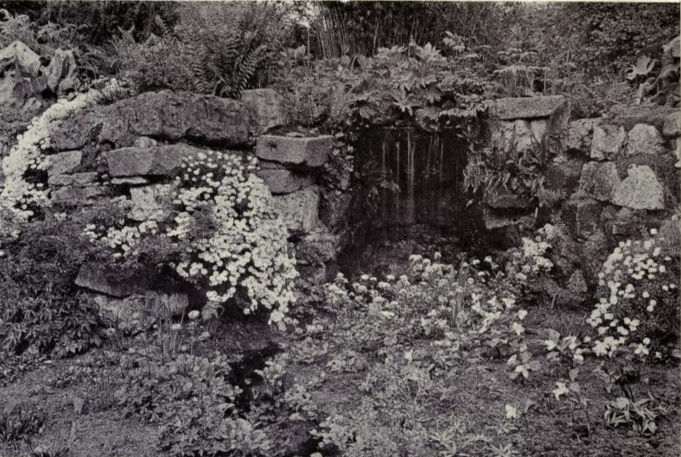
I also came upon a series of articles in The Garden [April 1, 1893], titled ‘The Rock Garden’, by F.W. Meyer (1852-1906), concerning the use of water in rock gardens. Meyer, who worked as a landscape gardener for the famed Veitch nurseries for some 30 years, eventually specialising in water gardens and rockwork, wrote that a “very pretty effect may be produced from a dripping fall in front of a cave for Killarney or other Filmy Ferns” – much like in the photograph above.
This effect was generated by letting the water drop into shallow pools and “so arranged that the rebounding drops would send a very fine spray over the delicate fronds of Ferns...”. If the water was allowed to splash onto stones, instead of water, it might damage the delicate plants – while water splashing onto them directly from a water pipe would be too cold. Incidentally, an article in The Garden [January 27, 1894] includes a brief mention of filmy ferns at Veitch's nursery in Chelsea where several hardy species of Hymenophyllums, Trichomanes, and Todeas grew happily "unheated and unprotected”, even though the weather at the time was noted as being cold and icy.
Another filmy fern 'house' features in the photograph below. Published in Gardening Illustrated [April 22, 1899], it depicts the fernery of a Captain W. Belfield of Malmains, in Frenchay, near Bristol. Belfield writing in the accompanying article that the filmies were "beautiful beyond expression” and that, if given a suitable place, would “thrive wonderfully”, especially if kept in a ‘house’ “to themselves, kept fairly dark, with plenty of atmospheric moisture; [and with] no heat whatsoever…”.
‘Group of New Zealand Filmy Ferns’ [in Captain Belfield's filmy fern 'house']. From 'Gardening Illustrated', April 22, 1899 [Note the larger Todeas in pots, with smaller ferns underneath.]

An article in The Garden from a couple of years earlier [September 4, 1897], titled ‘Todeas at Frenchay’, provides a little more detail. It describes Belfield’s collection of filmies “arranged in a low lean-to house”. His collection mostly consisting [at this time] principally of 2 species – Todea superba and T. pellucida, having been, according to the article, “collected personally [by him]… in New Zealand”. Interestingly, his filmy fern house was “an annexe to a large temperate fernery… entered from here only” – the one entrance being to ensure no drying wind reached the delicate filmies, while the use of “heavy shading” combined to keep the cool, moist atmosphere required.
And here, a tantalising conundrum relating to Belfield and his filmies. Willmott’s archive lists a letter [amongst her correspondence with and from ‘Growers'] from a Miss Warner from his address, ‘Malmains’, although no date is given. She is listed as a “correspondent for ferns from New Zealand”. I have not seen the actual letter, but perhaps Willmott obtained New Zealand ferns, and possibly filmies, via Miss Warner, or from Belfield’s own collection, or even from a New Zealand contact of his? And this leads me nicely into discussing other sources for Willmott's filmies.
Willmott's sources for her filmy ferns
As to other possible sources, unfortunately there's not much actual evidence of where Willmott obtained them, although there are tantalising snippets of information, often from correspondence in the Willmott archive [as above], that point to possible suppliers. I only have access to a list of Willmott's correspondents compiled some years ago, which gives a very brief description of what the letters relate to [and not the actual letters themselves], which often makes it a frustrating business – and the more recently unearthed treasure trove of Willmott correspondence and archival material is not yet publicly available. Therefore, it's largely guesswork and some supposition on my part.
Filmies from New Zealand
According to Sandra Lawrence's new book, one initial main source for her collection of filmies was in all probability her uncle, Charles Willmott, who had emigrated to New Zealand a few years earlier. He may have sent his niece spores, seedlings or cuttings [the latter two having a good chance of surviving the long journey if sent via Wardian case], but I don't think it's known for certain.
Backhouse & Son of York
Another source is almost certainly to have been Backhouse & Son, the company having been employed by Willmott to construct her alpine gorge and rock garden and, just a few years later, her filmy fern cave [more on this later].
J. Backhouse & Son., '1871 Catalogue of Hymenophyllums and Trichomanes'

Backhouse & Son often advertised themselves as filmy fern specialists, as can be seen from one of their advertisements [below], and produced specific catalogues of the filmies they had for sale, including that for 1871 – link below
William Robinson, writing in The Garden magazine in 1891 [as owner and Editor, and reporting upon the death of James Backhouse 4* (1825-1890) the previous summer], mentions the construction of an underground fernery at their nursery for the cultivation of filmy ferns; their collection included a fine specimen of the Killarney Fern, as well as filmies from New Zealand, Chile, Java, the West Indies, and elsewhere. [*Note: As there were a succession of James's in the Backhouse family, they are referenced by numbers. The two pertinent James' in relation to this post are 4, as above, and his son, James Backhouse 5, mentioned later on.]
Backhouse & Son advertisement for Filmy Ferns, 1905. Public Domain

And, as pointed out by an article in The Garden in July 1890, Backhouse did much to popularise filmies by showing a collection at that year’s Royal Horticultural Society's Temple Show (one of the RHS's London venues for their regular flower shows before the permanent move in Chelsea in 1913) – the article’s author noting that their exhibit “should induce people to… grow these beautiful and delicate plants”.
Articles in the horticultural press show that collectors of filmies did exhibit them at RHS shows from time to time, despite the difficulty of maintaining the right conditions. However, I've found no mention of Willmott ever doing so.
One of Willmott's photographs of the filmy fern Trichomanes reniforme [below], published in The Garden in October 1895 is particularly interesting in regards to the Backhouse connection. The species pictured, otherwise known as the Kidney Fern of New Zealand with unusual, kidney-shaped fronds and leaves 2-4 inches broad, looks to be growing on a stem of some sort, with moss around the base.
'Trichomanes reniforme. From a photograph by Miss Willmott’. From 'The Garden', October 26, 1895 [Native of New Zealand]

In all likelihood, it's the stem of a tree fern. Not only because the article points out that this species succeeds “equally well either on a Tree Fern stem or with its slender rhizomes running into soft sandstone broken into small pieces and mixed with rough, fibrous peat”, but also as there's evidence that Backhouse supplied Willmott with 2 tree-fern stems covered with seedling ferns – Sandra Lawrence having found the relevant Backhouse invoices during her research [Note 6].
This method, considered something of a novelty at the time, is also mentioned in The Garden [November 29,1890]. The article, written by an unnamed author reporting on a visit to the Backhouse nursery, also mentions the advantage of using the stems [so presumably he saw some filmies growing this way at the nursery] in that they hold a great deal of moisture – as well as being a beautiful way to display such small, delicate little plants. [And, as noted earlier, some filmies were known to naturally grow on decaying pieces of tree fern.]
'Trichomanes reniforme', the Kidney Fern. In the wild, this beautiful little fern usually creeps along the forest floor. Photograph Steve Reekie, 2011 under Creative Commons

P.B. O’Kelly of the Burren
There's also written evidence, set out in an article in The Kew Magazine in 1990 [Note 7], that Willmott bought ferns [although filmies are not specifically mentioned] from Patrick O'Kelly, a nurseryman and self-taught botanist, who was a prolific collector of ferns, plants and orchids in his native Ireland. O'Kelly was apparently something of a 'character', who often over-emphasized the rarity of some of his plants, but he was no less a knowledgeable plantsman for all that. His so-called 'Ballyvaghan Botanic Gardens and Ferns Nurseries' were based in Ballyvaghan in County Clare. Willmott received numerous plants from O’Kelly in May 1905 at a cost of £17 2s, all plants priced at one shilling, while he later sent five parcels of plants, writing to Willmott that: "it will take me closing [sic] on two months to supply the remainder of your order as I have to travel far distances to counties in Ireland for some of them…”.
O'Kelly issued a catalogue of plants and ferns he could supply, at a cost of 3d, and the Willmott archive also contains a copy of his second catalogue [c.1895], described in the article as "an elaborate 29 page booklet". The article only mentions Willmott purchasing 'ferns', but as some 22 letters from O’Kelly to her between 1905-07 survive, presumably about plant orders, it may be that she sourced filmies from him.
W. & J. Birkenhead Fern Nursery in Sale, near Manchester
'Catalogue of Ferns cultivated by W. & J. Birkenhead Fern Nursery, Sale, near Manchester'. 1899

W. & J. Birkenhead was one of the largest suppliers of ferns in the country at this time. I have no evidence that Willmott purchased ferns or filmy ferns from them, but it seems likely – especially as she's famous for sparing no expense when it came to buying prodigious amounts of plants.
Whether Willmott purchased from them or not, it's interesting to look at Birkenhead's 1899 catalogue as it gives prices for various filmy fern species including Hymenophyllums and Trichomanes [below].
Extract from Birkenhead’s 1899
Fern catalogue [below] showing prices for Hymenophyllums
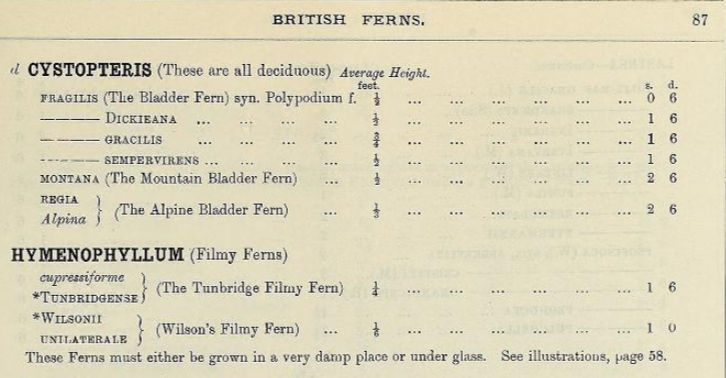
Extract from Birkenhead’s 1899 Fern catalogue showing prices for Trichomanes [Note: today's equivalent of one shilling ranges between £6 and £9, depending on inflation index used.]

Additionally, the Birkenhead’s catalogue also gives some information regarding filmies exhibited at a Flower Show, probably an RHS show. It quotes from The Times [of May 30, 1899, in the kind of written language I so love from this period!] reporting on displays of filmies by both Birkenhead and Backhouse, that “in one of the tents were the Filmy Ferns, rarely or never seen before in such beauty and variety… With little pearls of dew gemming every point of the cool green fronds, they were most agreeable to look upon, and it was difficult to believe that, even with the protection of glass shades, these natives of caves and of tropical forests could be exposed without danger in a canvas tent”.
Patrick Neill Fraser (1830-1905) of Murrayfield, Edinburgh
Willmott’s archival list of correspondents includes letters between 1904-1906 from Charles Druery [President of the British Pterological Society], one introducing her to a Patrick Neill Fraser, who could “collect ferns”. There are also letters to Willmott from Neill Fraser, although dates are not noted.
Interestingly, Neill Fraser [his surname, despite no hyphen], described as a prominent Scottish printer, horticulturalist, and fern enthusiast based in Edinburgh, had a fine garden in the Murrayfield area of the city, where he specialised in growing hardy and tender ferns, alpine plants, and polyanthus. In 1865, he compiled and published A List of British Ferns and their Varieties; this 9-page booklet lists mostly hardy ferns, but does include a few species of Hymenophyllums and Trichomanes [available online – see Note 8].
Neill Fraser was obviously an important figure in the Scottish horticultural world as he also pops up in the Journal of the Botanical Society of Edinburgh, being a member and serving as its Treasurer for some years. As to the fern connection, in December 1879 [Note 8 again], it’s also noted that he gifted the Society with seeds “imported from New Zealand” [the home of many filmy fern species] as well as donating fronds of a Dicksonia [tree fern] from the New Hebrides in the South Pacific for their herbarium.
Other evidence points to Neill Fraser's expertise with ferns: sometime in 1895-96 he was in Jamaica with the President of the Society, the Rev. David Paul, looking at ferns [Note 9]. Paul later read a paper to the Society regarding this trip titled ‘On the Ferns, especially the Filmy Ferns, of Jamaica’ where he discusses them at length and says that for some of his time there, he “had the advantage of having as a companion in fern-rambles…Mr. Neill Fraser, whose knowledge of fern botany is both accurate and extensive”.
Considering that Willmott had a huge number of connections with important figures in the horticultural and botanical world, not only in the UK but across the globe, I think all this speaks to Neill Fraser possibly providing Willmott with ferns, and perhaps some species of filmy ferns.
Willmott's Warley Place
Before I discuss the filmy fern cave, it's probably a good idea to orient ourselves as to where it lay within the area of the alpine gorge and rock garden at Warley Place. The William Walker map of 1904 (below) shows what was once the entirety of the Warley estate – of which, today, only a small part remains run as a nature reserve by the Essex Wildlife Trust [roughly the green area top left].
William Walker Map of Warley Place, 1904. Pen, ink and watercolour, 13 ½ by 20 inches. Courtesy Essex Wildlife Trust

Below: enlarged area [top left on the map above] showing: G - Alpine rock garden with pools and waterfall; H – Bridge over runnel [watercourse or stream]; I – Filmy Fern Cave; J – Crocus Lawn [described by the Rev. Engelheart – see below]

Written descriptions of Willmott's filmy fern cave
Just as with the filmies themselves, I've looked for descriptions of the cave from garden writings of the time. Unfortunately, my usual go-to sources for information on the garden and plants at Warley Place provide little or no comment on the cave – Henri Correvon, Swiss nurseryman and mentor to Willmott, in his series of detailed articles in The Garden titled ‘The Gardens of Warley Place’ [August 1905] writes in detail of her rock and alpine garden, and its plants, but makes no mention of the filmies or the cave.
However, J.C. Shenstone of the Essex Field Club, in his lengthy report of a Club visit to Warley Place in 1912 [Note 10], writes briefly of the filmy fern cave: “A grotto to the south is devoted to 'Filmy-ferns', and in passing from the open into the cool diffused light the contrast is delightful. In this grotto one finds Trichomanes cruentium and T. reniforme from New Zealand, T. radicans from Killarney, Hymenophylum tunbridgense from Westmoreland, and H. demissum from New Zealand”.
Fortunately, the unnamed author of an earlier article, published in The Garden in August 1895, provides a brief description, writing of the additions to her famed rock garden – which included the filmy fern cave:
“At its lower extremity, cunningly combined and constructed so as to form part of the rock garden, yet with a flat roof of glass overhead, and with closed end, a house has been made and planted entirely with Filmy Ferns in variety. Many of them already show signs of doing well, and without a doubt ere long this cleverly arranged home for them will be a most beautiful spot, and its charms the greater because of its unobtrusive character, as one has not the least idea of the existence of the structure till it is entered”.
From what I've read in the Victorian horticultural press, these particular ferneries or filmy fern 'houses' were indeed generally kept out of sight of the casual visitor. Probably a mixture of keeping visits to the cave limited to preserve the atmosphere, as well as to protect the delicate ferns. It also, of course, made it a more 'secret' space in the garden for the enjoyment of its owner.
Willmott's friend, and famed daffodil expert, The Rev. George Engelheart, wrote an article for The Garden 5 years later [January 1900, about its daffodils, 'Daffodils at Warley Place'], which includes a brief description of the cave [so he was allowed in...]: “…you walk, all unconscious, over a stretch of green turf, purpled in February with sheets of the rare wild Crocus [presumably the 'crocus lawn' as indicated by 'J' on the map above], until it suddenly lips over into a miniature stream-bottomed valley... At the lower end of the ravine the streamlet flows through a cunningly built cave, the dimly-lit and ever moist abode of the choicest Filmy and other Ferns”.
‘A well-grown Filmy Fern (Hymenopyllum). From a photograph sent by Miss Willmott, Warley Place, Essex’. From 'Gardening Illustrated', October 26, 1895 [No species noted]

And that's it. There's nothing else in the horticultural press or garden writings of the time that I've found, usually my best resource for detailed descriptions of Willmott's garden and plants. [There is one exception to this – a poor quality rendering of another Willmott photograph of Todea pellucida which I've not included.]
Fortunately, invoices from Backhouse & Son in relation to the construction of the cave detailed in Sandra's book provides more evidence, while a modern archaeological survey, and detailed descriptions of Backhouse's own fernery of filmies, allow some comparisons to be made.
Backhouse & Son invoices
Sandra Lawrence's new book includes a brief chapter on the filmy fern cave, where she details how newly discovered Backhouse invoices provide us with some fascinating information as to its creation.
Built by James Backhouse & Co., only some 3 years after completion of Willmott's hugely expensive alpine and rock garden (with its large man-made ravine), during the winter of 1894/95 they began construction on a home for her growing collection of filmies. As Sandra details, "with giant blocks for walls and two massive rock arches", the cave measured some 12m long, 6m wide and 2m high – designed with natural-looking alcoves and niches.
The filmy fern cave showing the first stone arch with girder and western entrance's oak door remains, and the second arch beyond. Photograph courtesy John Cannell, 2009 [The girders would have supported a thick plate glass roof. Accumulated debris has risen the floor level substantially]

The invoices evidence the time spent by Backhouse employees at Warley; materials used, including tonnes of stone and yards of flagstones; fixtures and fittings (such as locks, hinges, “gothic-style” brass handles, and keys for the east and west oak doors); and even such items as bark mulch, as well as wire baskets, 14 cubic yards of peat [the recommended growing medium], and other assorted gardening bits and bobs. Also, 130 of what were, presumably decorative, "12 inch fern tiles for the interior". It's a shame that, to my knowledge, no surviving pieces have been found. However, Warley Place is renowned for occasionally giving up a secret or two, so perhaps some time in the future!
The book includes this beautiful, but undated, photograph by Willmott herself of the eastern entrance to her filmy fern cave – the only one I've ever seen [modern photographs only feature the western entrance, as the eastern side is now blocked by accumulations of sand and debris, and its door is long gone]. Note the oak door and the sandstone path leading into it, with large stones and rocks on both sides, artfully arranged by the Backhouse team to look as natural as possible.
‘The Filmy Fern Cave’s east entrance, probably the most accessible for visitors’. By Ellen Willmott, date unknown. Courtesy Berkeley Family and Spetchley Gardens Charitable Trust. From ‘Miss Willmott’s Secret Weapon’ by Sandra Lawrence, 2025 [Note: I've lightened this image to make the oak door more visible]
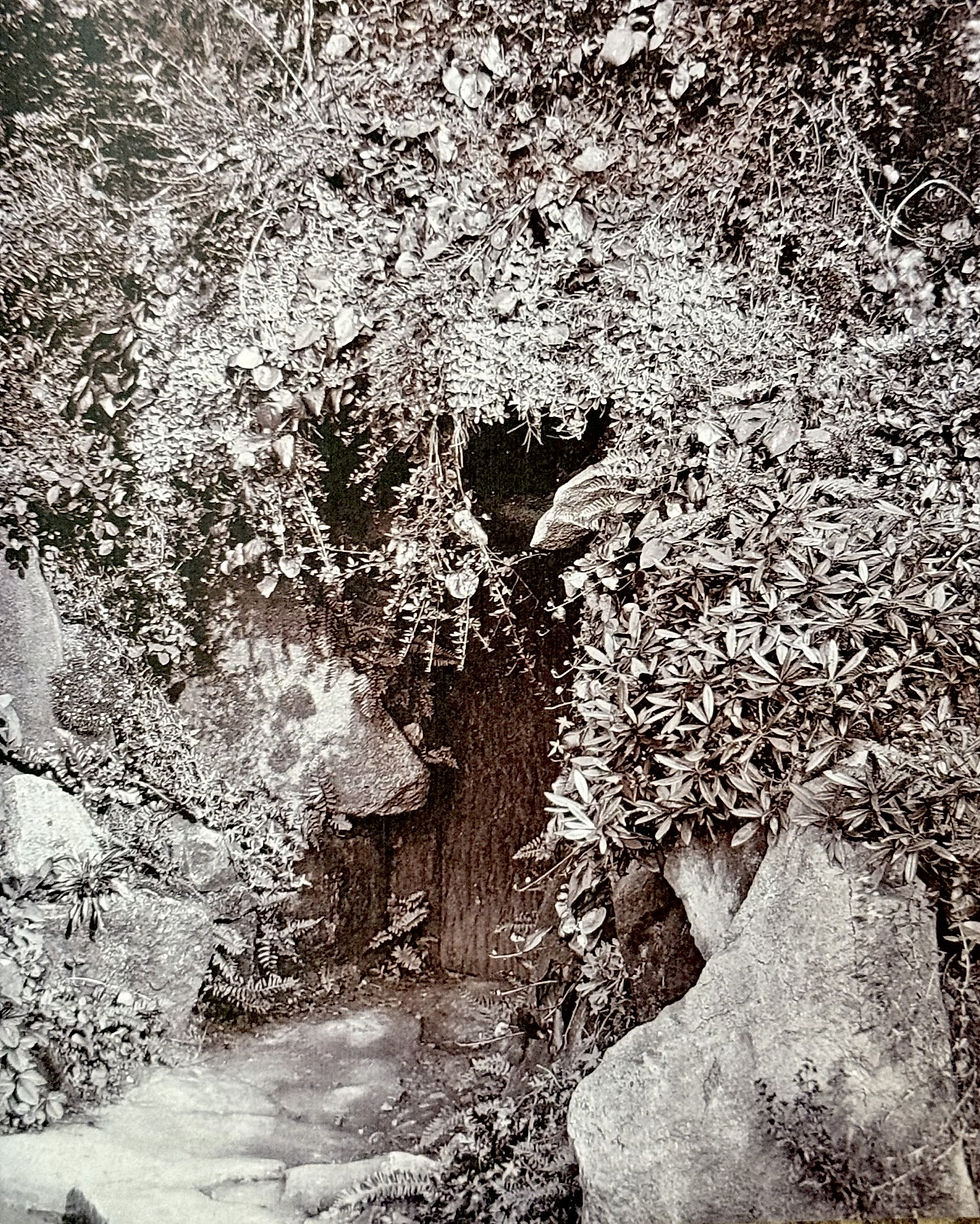
Interestingly, one Backhouse employee, a Mr. Potter is noted as spending a total of 6 extra days working on the “Trichomane cave” in 1895. Could this be referring to the filmy fern cave itself, or to the smaller cave at the end [referred to as the apsidal area" – meaning 'a semi-circular end of a building, covered with a hemispherical dome or vault' (more on this below)]? Apparently, Potter spent even more time at Warley Place in the winter of 1896 supervising “more rocks and more planting”.
And here to mention that Sandra’s work on the undocumented Willmott archival material shows that her famed alpine gorge was not, as usually thought, built in the 1880’s [it's always said it was Willmott’s 21st birthday project] – but in all probability later in the 1890’s as evidenced by the Backhouse invoices.
The 'filmy fern cave' at Warley Place – a Modern Survey
In 1999, the Essex County Council's Field Archaeology Unit carried out a survey, and limited excavation, of the filmy fern cave at Warley Place [Note 11]. Their report states that the cave, running roughly east-west, had a "sandstone-flagged path" running along its length, with a door at each end. Remains of the western, solid oak door remain – as can be seen on the left in my photograph below from 2011. The other door [at the eastern entrance and shown in Willmott's photograph above] no longer survives [except for pieces of brass door furniture] and that end of the cave is now blocked by sand and decades of debris.
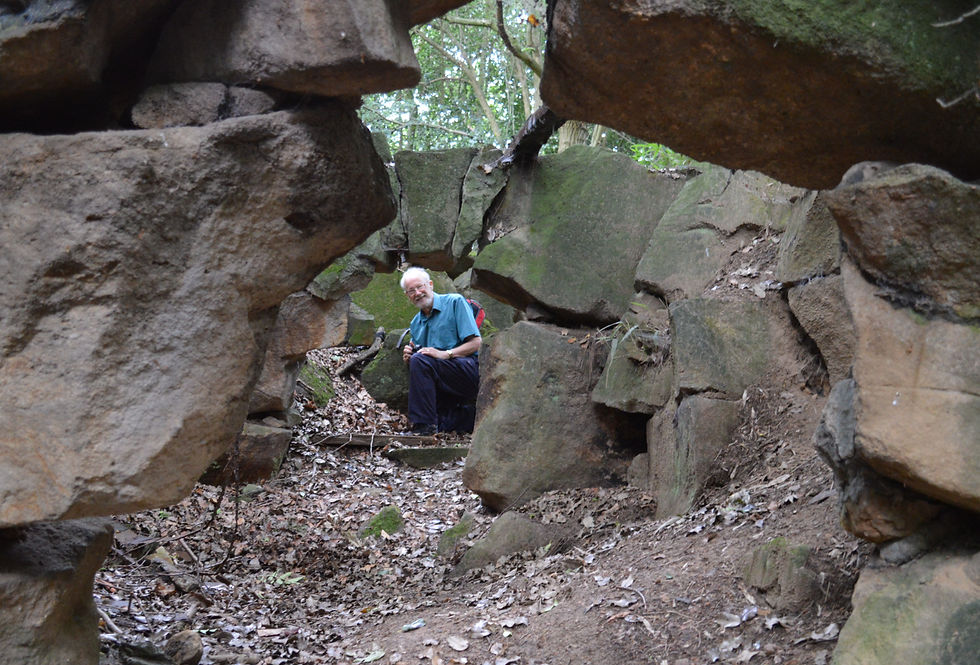
From my photograph below, once through the western door the path wound round to the left and passed under the first stone arch. The photograph below this one, taken by Sandra Lawrence in 2019, shows Warley Place volunteer, John Cannell, crouching underneath the second arch. Although, the eastern entrance is thought to have been the main entrance.
The remains of Miss Willmott’s filmy fern grotto. On the left can be seen the remains of the western entrance's oak door. My photograph, 2011
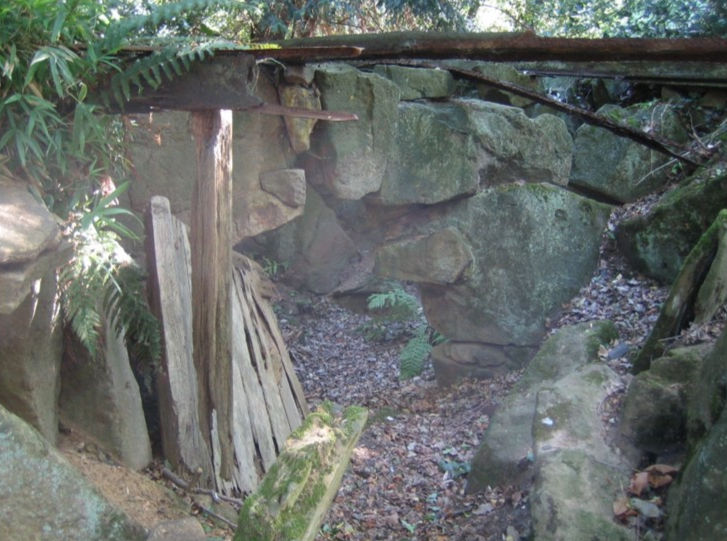
The survey records that two sandstone arches divided the cave into three separate bays, with a smaller arch at the eastern end leading into a small "apsidal area" – meaning 'a semi-circular end of a building, covered with a hemispherical dome or vault' [as mentioned above could this be the Trichomanes cave referred to in the Backhouse invoices?]. They also found "the remains of raised planters, formed in sandstone, in the walls on each side of the cave, and possibly smaller niches adjoining the bases of the two transverse arches". Such alcoves and niches no doubt used for additional plantings or pots.
Looking through the filmy fern cave towards the western end of the cave, Warley Place volunteer, John Cannell, crouches underneath one of the main arches. During Willmott's time, the floor would of course have been much lower. Photograph courtesy of Sandra Lawrence, July 2019
The once "glazed roof" of greenish 1/2 inch plate glass had been supported by steel joists running the length of the cave, in turn supporting "T-shaped glazing bars at right angles". Fragments of glass and glazing bars were found during the survey's excavation, and shards of the glass still turn up from time to time – as can been seen in the photograph below. This "greenish" glass no doubt creating "the cool diffused light" so admired by Shenstone in his 1912 article.
Shard of roof glass from the filmy fern cave. Photograph courtesy Essex Wildlife Trust

Strangely, the survey found no evidence of any internal water supply [pipes or remains of tanks], despite the cave having to be kept continually moist, concluding that the "floor level was too high for any water to have flowed in from the adjoining gorge" [through which a stream ran at the time]. Two brass nozzles, possibly from hand-held pumps, were found – perhaps for spraying the ferns. I've found no written contemporary description of how Willmott's filmies were provided with the moisture that was so essential to their survival. And yet there must have been – Engleheart described the cave as an "ever moist abode...”. If it was indeed just left to Willmott's gardeners to spray the filmies, it would have been an unending job...
The report also puzzled over the find of 2 circular sheets of window glass, just over 3 inches in diameter. It was thought that "these may have been used for covering flowerpots containing small plants or seeds requiring a high level of humidity". [Certainly possible – although for seeds, read spores or seedlings. Ferns having no seeds per se.] Also found were pieces of thinner glass, and the report surmises that this glass may have been used as a window, or as "filling" at both ends of the cave. However, it must be remembered that filmies were no fans of sunlight.
From my personal email correspondence with the 1999 Survey report's author, Dr Michael Leach [who knows Warley Place very well – Note 13], trying to work out what system was used to provide the cave with the necessary moisture, or to find evidence of what The Rev Engelheart described as a "streamlet" flowing through it, is difficult. The modern-day higher ground level makes it difficult to work out, with any such evidence probably deeply buried.
An entry on The Alpine Gorge and Filmy Fern Cave at Warley Place in a more recent report in October 2020 [Note 12], produced by Land of the Fanns/The Gardens Trust, reports basically the same information as in 1999, but notes its importance in a more historical context .
As this report points out, Willmott’s filmy fern cave, "a rare survivor" of this type of fern habitat, was "designed and constructed to create differing but ideal microclimates that suited a vast collection of plants from around the world" and, just like her Backhouse-built alpine rock garden and gorge, was constructed to look like “a perfectly natural feature of the landscape” .
Comparisons in the contemporary press
As much of what's known about Willmott's filmy fern cave today depends on the limited physical evidence that survives and the 1999 survey, much of it is still conjectural. Therefore, I've looked at descriptions of other Victorian filmy fern caves, particularly those built by Backhouse, to see if any comparisons can be drawn.
The most pertinent is, of course, the underground fernery of James Backhouse & Son of York themselves. There are two articles in the horticultural press, September 1873 and July 1900, both by unnamed authors writing about visits to the Backhouse nursery. Both articles discuss the construction of the filmy fern house, its maintenance, and the filmies grown. Even more informative however, is a later paper, written by Backhouse himself [James Backhouse 5 (1861-1945)], and read to a meeting of the RHS in 1894 [and published in their Journal], which gives some additional information – and provides some alternatives for how the necessary moist atmosphere was achieved.
As already mentioned, I've not found any internal images of the Backhouse's 'house', but an article in The Gardeners' Chronicle in September, 1899 reports on that of a Dr. Winter in Brighton – and it's accompanied by two beautiful photographs of his underground fernery, which show some of the same features as noted in the Backhouse and Willmott 'houses'. [More information of Dr. Winter below.]
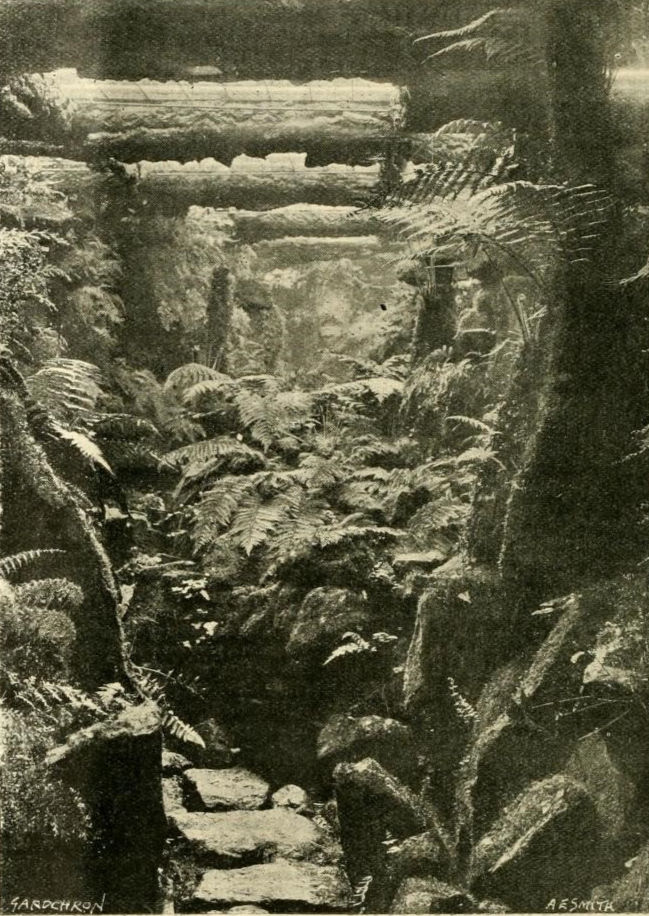
‘A View in Dr. Winter’s Underground Fernery’. From 'The Gardeners’ Chronicle', September 9, 1899 [This photograph clearly shows the stand-stone blocks and the glass roof. Also note what looks like a pot on the wall on the right, probably sitting on a rocky outcrop]
I've also found a very brief article about filmies growing in the fernery at the Manchester Botanical Gardens ,which mentions their method of providing the required conditions.
Articles in date order:
Article: 'Messrs. Backhouse & Son’s York. No. 2'
Journal of Horticulture and Cottage Gardener, September 11, 1873
This article describes the Backhouse's underground fernery [home to some 90-100 species of Trichomanes, Hymenophyllums, and others, including “a lovely mass of the beautiful H. tunbridgense…”] as being “perhaps the most unique spot…” in the entire nursery. 120 tons of rough sandstone had been used in its construction – it was about 9-10 ft deep, and narrow with a roof of thick glass and iron. Tucked away out of sight of the public due to the delicate nature of its inhabitants, the fernery was in 2 sections. One end being heated by a warm tank for those filmies requiring a tropical climate, the rest being for the more hardy species. The sections were merely divided by a stone arch – no door.
The Backhouse cave utilised the warm air produced above the warm water tank in a rather simple, but clever way to produce the required condensation. As the warm air reached the stone arch, it met a cool current of air from the other, cooler, section of the cave. The warm air would pass under the cool air, resulting in a “condensation of vapour”. This resulted, according to the article's author, in “a continued dripping and a most beautiful deposition of the finest dew”, which no sprinkling or syringing could produce, and therefore the plants “live in the very atmosphere most suited to them”.
Such stone arches are also present in Warley's cave, but this method required a water tank – of which no evidence has been found.
The New Fernery in the Manchester Botanical Gardens.
The Gardeners’ Magazine, November 25th, 1882
Another method for providing filmies with their required conditions is mentioned, briefly, in an article in The Gardeners’ Magazine [November 25, 1882] reporting on the opening of a new Fernery in Manchester’s Botanical Gardens. The idea being, according to the article, to imitate nature by showing the plants in “harmonious surroundings”. In this case, to accommodate the inclusion of filmies, a “moderate” water supply using“ small streamlets and ‘dripping wells’ "leading… over a series of rocks” was used, although it also mentions that many of the specimens were in pots. This garden was located in the Old Trafford area of Manchester, but is long gone having been sold off in 1907. Again, this method would presumably have required tanks and pipework.
'View in the New Fernery, Manchester Botanical Gardens'. From 'The Gardeners’ Magazine', November 25th, 1882

'James Backhouse and Son, Ltd, York'.
The Gardeners' Chronicle, July 7th, 1900
The later article about the Backhouse fernery provides some additional information and the description below does, I think, probably fit with what is known of the Warley Place cave:
“A series of projections upon one side of the paths, and of recesses upon the other side, cause them to appear to be impassable, but they wind around the forbidding-looking obstructions, and between the drooping, arched fronds of the larger growing Ferns, something beautiful is revealed to the sight at each step the visitor takes”.
The photograph below shows the entrance to the fern cave at the Backhouse nursery in York. Dating from 1891, it shows stepping stones providing access across the stream to the fern cave – possibly housing their collection of filmies although this is not stated categorically. There was a door into the cave [but it can't be seen in this image], just as at Warley, but I have to say this entrance looks a little hazardous!
‘Cave in the Rock Garden’ at the Backhouse Nursery in York. Lantern slide c.1891. Courtesy Discover York Digital Library-Collection: Backhouse Nursery glass slides

Amongst filmies noted were many grown by Willmott: H. caudiculatum “sweeping up the rocks”, as well as H. cristatum. Growing in the warmer section of the cave were filmies such as [and here I just list others also grown by Willmott] as T. radicans (the Killarney fern); Hymenophyllum demissum; while in the cooler section were “fine masses of Todea superba, and others; also a very good specimen of Trichomanes reniforme".
Unattributed photograph 'Filmy Fern (Todea pellicida)'. From 'Gardening Illustrated', January 4, 1896 [The article described the ideal position for filmy ferns as “a cave with the water constantly dripping about in small quantities, and perhaps, a natural stream running through”]

‘Filmy Ferns and their Cultivation’, a paper by Mr J. Backhouse, read at an RHS meeting on July 24, 1894. From the Journal of the Royal Horticultural Society of London, vol.17, 1894-1895
But it's this paper, by James Backhouse 5, that provides a first-hand account of the Backhouse filmies. He writes that the best way to grow them was in an “underground fernery” where conditions could be more readily reproduced – planting them in “the chinks of moisture-laden rocks [presumably the often recommended sandstone] or cavernous recesses…”. Interestingly, in this paper he mentions that the filmy fern cave at the Backhouse nursery, built by his father, James Backhouse 4, used a land-drain [no natural stream being available] some 10ft or so below the surface of the ground. Digging out the earth on either side and around it, in the form of a “winding glen” into which he put large stones/rocks, with many ‘nooks and crannies’, and in this way presumably obtained the required moisture in the cave. [I asked knowledgeable Warley Place volunteer, John Cannell, about this, but no such drainage system has been found in the cave to date.]
The roof, just like at Warley, was formed of “thick rough plate-glass placed flat upon iron girders...so as almost entirely to escape observation”. The entrance was by a “winding stairway of rough stone steps through a rustic door, which is kept closed to exclude heat in the summer and cold in winter and all withering winds”. Again, the large oak doors at the Warley cave would presumably serve the same function, although I know of no steps being found at Warley.
Interestingly, Backhouse added that in this fernery, the filmies were perfectly happy and that “such a house needs little attention”. There was no artificial heat provided [but presumably it had hot water pipes running through it to heat up the water tank?], and the temperature remained constant, with only a covering of mats given in the coldest winters.
Article: 'Filmy Ferns at Dr. Winter’s, Brighton'
The Gardeners’ Chronicle, September 9, 1899
This article describes Dr. Winter's subterranean fernery "in which the Filmies luxuriate, and give but little trouble”, which extended the whole length of his garden. He grew a variety of "pretty species”, including many filmies from New Zealand, as well as famed British species. His fernery had the added advantage of thick glass, fixed in iron frames, to provide the “necessary subdued light” – not unlike the modern description of Willmott's cave.
Also, like the Backhouse house, Winter’s fernery had a floor of sandstone blocks, although this article notes that a narrow stream of water trickled through the chinks in the blocks – the water being supplied by pipes running the whole length of the rock. It also had overhead perforated pipes which created the required moisture by condensation. No watering or syringing of the plants was therefore necessary.
‘Hymenophyllum Demissum' as growing in Dr. Winter’s Underground Fernery’. From 'The Gardeners’ Chronicle', September 9, 1899 [The glass roof can be seen more clearly in this photograph, as well as the overhead pipes]

Dr. Winter, a medical man, was something of an expert and filmy fern enthusiast. He had, according to the notice of his death in 1907 published in Kew's Bulletin of Miscellaneous Information [Note 14], studied botany under Dr. Lindley at the Chelsea Physic Garden where he "acquired a critical knowledge of plants" – and had for years "been a collector and grower of filmy ferns". His collection housed, according to Kew, an "extraordinary number of rare species...[noted] for the excellence of their cultivation".
Winter, who employed collectors to procure filmies for him from all parts of the world, also supplied them to Kew itself, as recorded in their ‘Miscellaneous Notes’ for 1914 [Note 15]. Kew was actively “rearranging and strengthening” their filmies collection at the time from a variety of sources – including Winter. The 'Notes' stating that: “The collection was further augmented by the purchase of a number of specimens from Dr. Winter of Brighton”. [Note: I did wonder if Dr. Winter could have supplied Willmott with filmies, but found no mention of him being one of her correspondents.]
Willmott and The British Pteridological Society
From my research, I've found very little in the horticultural press and gardening material of the time that actually speaks to Willmott's interest in ferns. Over the years, I've scoured The Garden, The Gardeners' Chronicle, and other gardening publications, for mentions of her numerous plant exhibits at RHS flower shows and others – but found no mention of her exhibiting ferns. And information gleaned from the other sources discussed in this post [apart from the Backhouse work on the filmy fern cave and the supporting invoices], is somewhat thin.
However... finding [from her archive listing] that she corresponded with Charles Druery – a key figure from the establishment of The British Pteridological Society in 1891, and President from 1898-1901, led me to check their journal, The British Fern Gazette, which is available on-line. [Interestingly, the Birkenhead family, of renowned fern nursery, W & J Birkenhead, mentioned earlier as one possible source for Willmott's filmies, were also key players in its history.]
Willmott is listed as joining the Society as a member in December 1927 – which surprised me as, by this time, her fortunes and the upkeep of her garden were very much on the slide. The Editor of the Gazette, in its December 1927 edition, reports on a substantial rise in the membership noting that Willmott, despite being a new member, had, with another, “themselves taken part in the recruiting programme…”, the Society being then involved in a recruitment drive following some financial problems.
Unfortunately, Willmott contributed no letters or papers to the Gazette that I've found. However, after her death in September 1934, the Gazette's December edition published an Obituary written by its President, W.B. Cranfield, FLS, FRHS, who apparently knew her well. Cranfield described her as possessing “a knowledge of horticultural subjects seldom exceeded”. While mentioning her work, and devotion to daffodils and roses, of ferns he wrote that: “As a member of our Society her interest in ferns lay more in the direction of uncommon species... [and] she possessed the majority of the finer forms”. He ended by writing that the horticultural world had lost one of its “best known individuals” [Note 16].
The end for filmies?
By the turn of the 20th century, filmy ferns seemed to have lost much of their status in the plant world – there are far less articles written about them for instance [the horticultural press, of course, tending to concentrate on the most fashionable new plants of the day], although this doesn’t mean that they didn't continue to be grown and enjoyed.
Also around this time, the so-called ‘tropical’ filmies all but disappeared from glasshouses – primarily, I think, as gardeners generally turned away from the expense of heating them, and the hardier, temperate, filmy ferns fared better. And, of course, after the first world war, many glasshouses were destroyed or abandoned as being too expensive to maintain, added to a dearth of available gardening staff.
Today, according to a few sources, including Exotica Esoterica (quoting PlantSearch, 2024), the Killarney bristle fern (Trichomanes speciosum) is probably the most widely cultivated species of filmy in research collections. They also note that in the mid-19th century, British fern collectors had access to at least 50 species of filmies, many of which would now be considered rare and desirable miniature ‘exotics’.
However, there are still keen filmy fern collectors, as can be seen in this short YouTube video posted by an enthusiast. It allows you to get up close and personal to some filmies, so please take a look: Unboxing Rare Filmy Ferns (plus 10 Month Growth Update!) - YouTube]
Conclusions
Willmott's filmies
Filmy ferns are, as a brief article in The Gardeners’ Magazine [February 5, 1898] so beautifully puts it, “ever a source of wonder and delight to those who love ferns… while to the uninitiated they [are]… most elegant, delicate, and beautiful…”.
However, I did come across one dissenting voice regarding the attraction of filmies. The great plant-hunter, Reginald Farrer (1880-1920), known to be somewhat prickly, wrote of them in his 1908 book, Alpines and Bog-Plants, that “the less said the better; they are as nearly impossible as any plants can be…”. Many plant collectors and keen horticulturists of the day, including Willmott, obviously thought otherwise, expending a lot of time and effort – and money, on cultivating filmies and providing them with the right conditions in which to thrive.
The best evidence currently available for just what 'filmy ferns' Willmott did grow, are her own photographs of various species published in the horticultural press; the list of the species she had at the time [as compiled from various sources]; as well as those few filmies named in the published articles that mention the filmy fern cave. Although how many others she may have grown we will probably never know. As already mentioned, it's highly unlikely any have survived at Warley Place.
The filmy fern cave
As to the cave, the 2020 report by Land of the Fanns/Gardens Trust points out [Note 12 again], that Willmott’s filmy fern cave is, today, "a rare survivor" of this type of fern habitat. It was "designed and constructed to create differing but ideal microclimates that suited a vast collection of plants from around the world" and, just like her Backhouse-built alpine rock garden and gorge, was constructed to look like “a perfectly natural feature of the landscape”.
I’ve also discovered just how rare this cave is. In 2024, the Yorkshire Gardens Trust pointed out that [while attempting to preserve gardens at Tudor Croft in Teeside which includes the remains of another Backhouse-constructed filmy fern ‘grotto’, albeit c. early 20th century], according to English Heritage, there are now only 2 remaining 19th century examples of filmy fern caves – that at Warley Place, and the other at Penjerrick in Cornwall [Note 17].
The remains of Warley's cave itself, although now considered a dangerous structure liable to collapse, is important [as pointed out in the 2020 report] in that it reflects the style of rock gardens of the period – particularly the work of the famed Backhouse nursery. As well, of course, as Willmott’s own dedication [and willingness to spend vast amounts of money I might add] in creating just the right conditions for her plant collections. Despite that, just how this was achieved still remains somewhat of a mystery.
Fortunately, due to Sandra Lawrence's research on the cave published in her recent book, together with the 1999 archaeological Survey, there's more information about the cave itself. And articles about other such caves – particularly those of the Backhouse nursery, Dr Winter, and Captain Belfield, show their construction was similar: namely, being underground, with thick glass roofs supported by girders; walls of stone blocks, flagstone (with often winding) paths, and solid doors to keep in a moist atmosphere, while presumably also keeping the casual visitor out!
Such large filmy fern caves were expensive, so not for an ordinary collector. Sandra writes that, from the Backhouse invoices currently available, she calculated that the filmy fern cave at Warley, “including materials, labour and expenses”, cost in the region of £1,265 – today, that's just over a whopping £139,000! Although, it has to be said, Willmott never spared any expense when it came to her garden and plants. And yet, despite such an expensive addition to her garden, virtually no other photographs of the cave – nor the filmies she grew there [apart from the few published], have yet been found.
The biggest question about the cave at Warley Place it seems to me [being now aware of what fussy little blighters the filmies actually are when kept in a man-made environment, despite garden writers of the day's enthusiasm for them], is just how the required atmosphere was created and maintained. As we've seen from descriptions of the other caves, there were differing systems used to provide this: warm air mixed with cold to produce condensation (via a warm water tank); tanks and pipes carrying water all around the cave; or water introduced into caves by streams or drainage tanks, seemingly being the main ones.
But still much is unknown. For example, during my research, I found only two articles that specifically discuss temperatures for filmy fern 'houses', meaning caves or grottoes. Gardening Illustrated [January 12, 1900] pointed out that filmies needed a supply of fresh air: “air should be conducted underground into the house, and made to pass over the hot-water pipes, before it discharged amongst the plants”. This would assist with keeping the winter temperature at a minimum of 50f (around 12c). Although another article pointed out that they should, on no account, be placed anywhere near such pipes [Gardening Illustrated, April 22, 1899]. Although this again leads me to ask, so where were the tanks and pipes at Warley?
And yet... there's no evidence, so far at least, of any internal water supply [as noted in the 1999 Survey] – whether pipes, tank work, or drains, which begs the question as to how the atmosphere was kept moist and humid enough? Although there was, at least at one point, a stream running through the cave as noted by The Rev. George Engelheart in his 1900 article. Perhaps this stream, in an enclosed space with a thick glass roof, was sufficient to produce, in Engelheart's words, "the dimly-lit and ever moist abode of the choicest Filmy and other Ferns”? Seems unlikely. And evidence for that today is also scant.
I'm particularly intrigued by mention of the Trichomane Cave in the Backhouse invoices – was this just a reference to the filmy fern cave itself, or did it mean the separate small apsidal area mentioned in the Survey? Were filmies with different atmospheric conditions kept in there, if it was indeed a separate roofed space? And I'd very much love to see remnants of the fern tiles pop up one day!
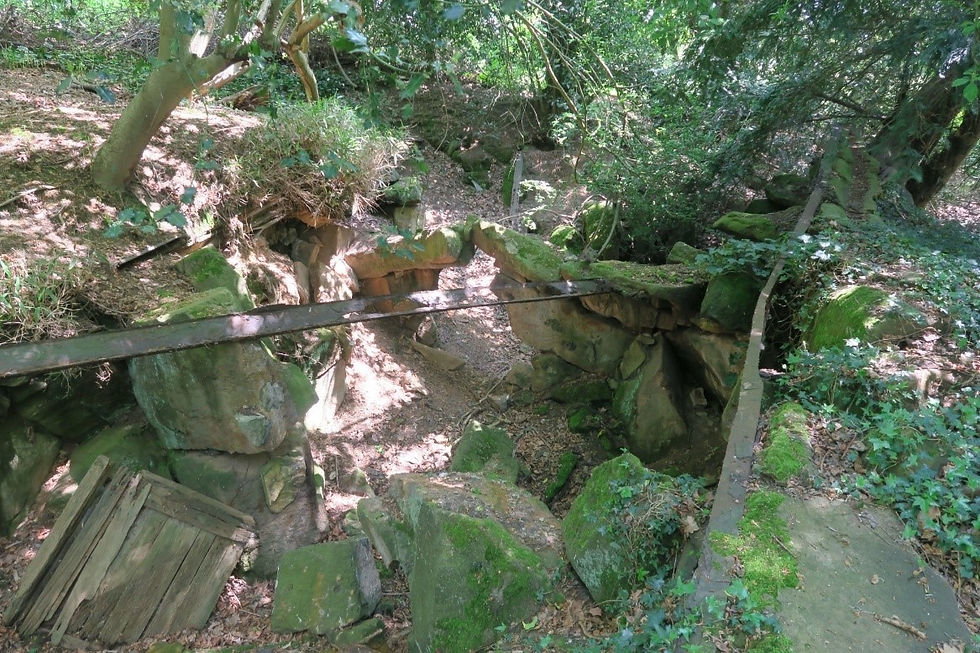
Unfortunately, since the above photographs of the cave were taken, it has deteriorated considerably, and sometime in the early summer of 2023 one of the arches collapsed – as detailed in Sandra Lawrence's post Dust to Dust, and shown in the photograph below https://misswillmottsghosts.com/2023/05/11/dust-to-dust/
And so, sadly, it probably won't be many more years before Miss Willmott's filmy fern cave is just a heap of rock. However, in the meantime, as those of us who love Warley Place know, it does, just occasionally, give up a secret or two – mostly, it has to be said, due to the hard-working group of volunteers who care for it. So more information or physical evidence may just one day turn up.
The filmy fern cave looking through the cave from above – the first stone arch has now collapsed. Photograph courtesy John Cannell, 2023
PS: I'd like to thank Sandra, Ailsa, John and Michael for answering all my many queries while writing this post. I usually have my nose pressed into the pages of the horticultural press when doing my research, but they all know the grounds, and history, of Warley Place much better than I. Any mistakes are therefore my own.
Notes:
1. From lists of plants grown by Willmott compiled from a variety of sources by Warley Place researcher/volunteer, John Cannell
2. A garden writer, E.T. Cook (1867-1915) was co-editor of The Garden magazine, with Gertrude Jekyll, from 1900-1902. He also wrote several gardening books, including Gardening for Beginners and The Century Book of Gardening.
3. ‘On the Flora of Australia’ by G.H. Adcock, FLS, FRHS. Journal of the Royal Horticultural Society of London, Vol. 22, 1898-1899
4. A History of British Ferns by Edward Newman, 5th Edition, 1874
5. The Royal Botanic Gardens, Kew: Historical and Descriptive by W.J. Bean, Kew's Assistant Curator, 2nd Edition, 1908
6. Backhouse invoice from November 1896 relating to the supply of 'two tree-fern stems covered with seedling ferns' as noted in Sandra Lawrence's book, Miss Willmott's Secret Weapon: The Alpine Garden at Warley Place and its Keeper, Jacob Maurer, published 2025.
7. ‘A Gem of the First Water’: P.B. O’Kelly of the Burren by E. Charles Nelson, The Kew Magazine, Vol.7,No.1 (February 1990)
8. Link to Neill Fraser's listing of British Ferns:
Transactions and Proceedings of the Botanical Society of Edinburgh, Vol.14, 1879-1883
9. 'Presidential Address – On the Ferns, especially the Filmy Ferns, of Jamaica'. By Rev. David Paul, L.L.D., Edinburgh. Delivered 8th November 1900. Transactions and Proceedings of the Botanical Society of Edinburgh, Vol.22, 1905
10. ‘The Gardens of Warley Place, Brentwood, Essex’ by J.C. Shenstone, FLS. From The Essex Naturalist, vol 17, 1912, the journal of the Essex Field Club
11. Some Notes on the Archaeological Examination of the Filmy Fern Cave by the Essex County Council Field Archaeology Unit, 1999, written by Dr. Michael Leach.
12. Report on The Alpine Gorge and Filmy Fern Cave at Warley Place from ‘Fifty Fabulous Features: Statements of Significance for Fifty Features of Historic Designed Landscapes within the Land of the Fanns'. Produced by the Land of the Fanns/The Gardens Trust, October 2020
13. Personal email correspondence with Dr Michael Leach, January, 2026
14. Bulletin of Miscellaneous Information (Royal Botanic Gardens, Kew), Vol.1907, No. 2.
15. Bulletin of Miscellaneous Information (Royal Botanic Gardens, Kew), Vol.1915, No. 1., ‘Additions and alterations to Gardens, 1914’
16. The British Fern Gazette, Vol.VI, No.11, December 1934
Yorkshire Gardens Trust letter to Redcar & Cleveland Borough Council, April 2024 [see Appendix] YGTLetHousingTudorCroftGuis0424v2.pdf
References:
For beautiful photographs of filmy ferns, and information regarding how they're doing in the wild today see the Exotica Esoterica website: Growing filmy ferns (Hymenophyllaceae: Trichomanes and Hymenophyllum) in terraria, gardens and open settings. — Exotica Esoterica
For those interested in the story of the Backhouse family, Gillian Parker has researched them extensively. Link to her 2023/24 article on the subject, Building the Foundations of the Backhouse Nursery of York https://eprints.whiterose.ac.uk/id/eprint/202227/1/Pre-publication%20version%20Backhouse%2C%20York%20Historian%2039.pdf


Comments